Why Your Conservatory Style Matters
When you request a quote for a conservatory roof replacement, the style and shape of your conservatory is one of the main factors affecting price and complexity. Different roof shapes have different numbers of hips, ridges, valleys, and angles — each one adds to the installation time and the materials required. Knowing your style in advance helps you understand what questions to ask and what to expect when we visit.
Lean-to Conservatory
The simplest and most affordable conservatory style. A lean-to has a single-pitched roof that slopes away from the house wall — think of a shed roof attached to the back of the house. They are typically rectangular in plan, with no hips, ridges or angled sections. This makes them the most straightforward roofs to replace and usually the most competitively priced. Lean-tos are very common on terraced and semi-detached houses where space and budget are priorities.
Identifying features: single slope, rectangular footprint, roof pitches away from the house wall, no ridge pole, often quite low in profile.
Victorian Conservatory
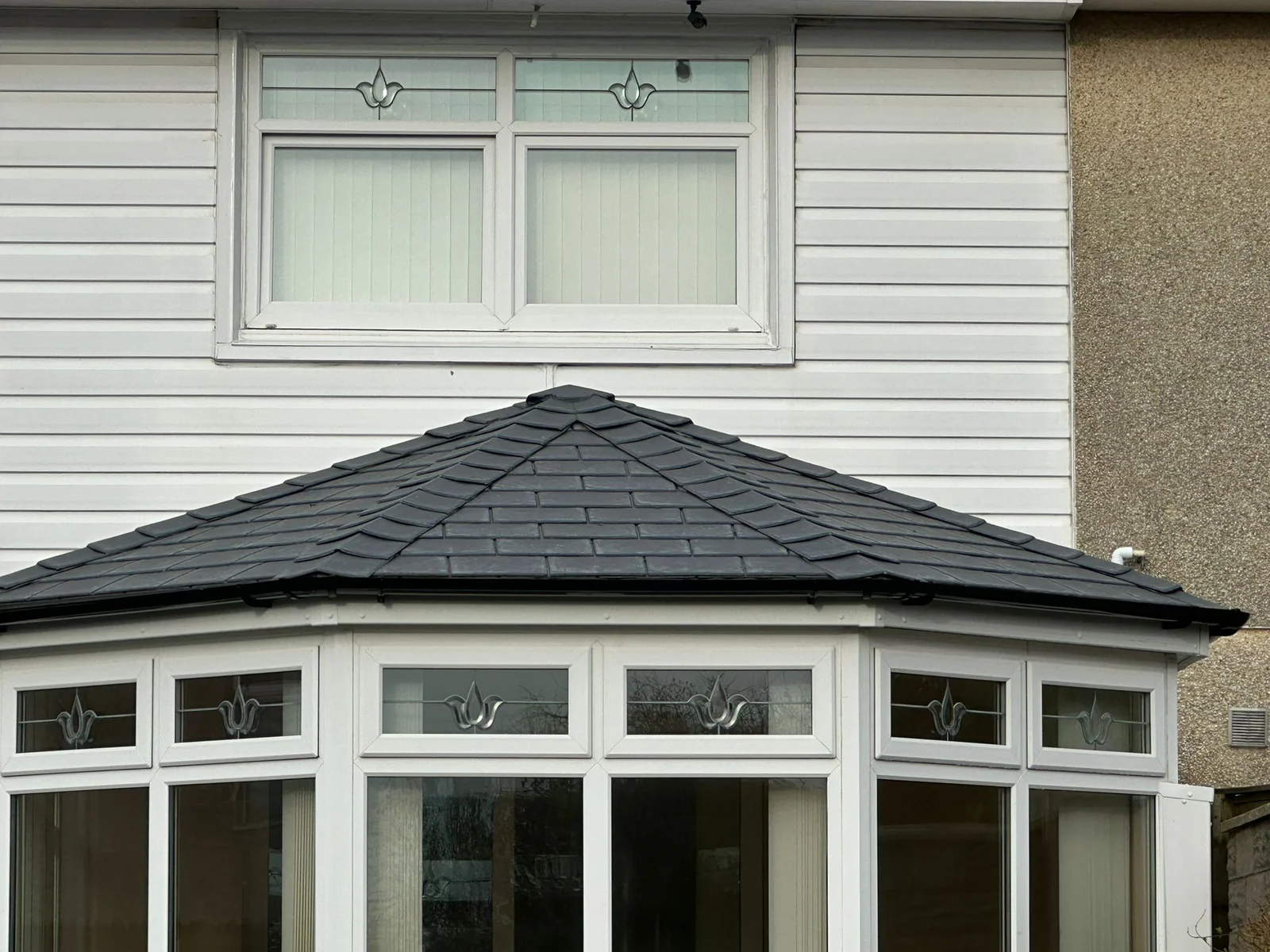
The Victorian style is the most recognisable and probably the most popular conservatory design in the UK. It features a multi-faceted bay front — typically five or seven sides — with a pointed roof that has multiple hips meeting at a central ridge. The bay shape gives the room a spacious, elegant feel and allows more natural light in from different angles.
Victorian conservatories are more complex to re-roof than lean-tos because of the multiple hip sections and the angled front bay. Materials costs are slightly higher and installation typically takes a little longer, but the end result is particularly striking with a tiled roof as the pitched profile suits tiles naturally.
Identifying features: multi-sided bay front (usually 5 or 7 panels), pointed or pyramidal roof, multiple ridges meeting at a central apex, ornate detailing on ridge and finials.
Edwardian (Georgian) Conservatory
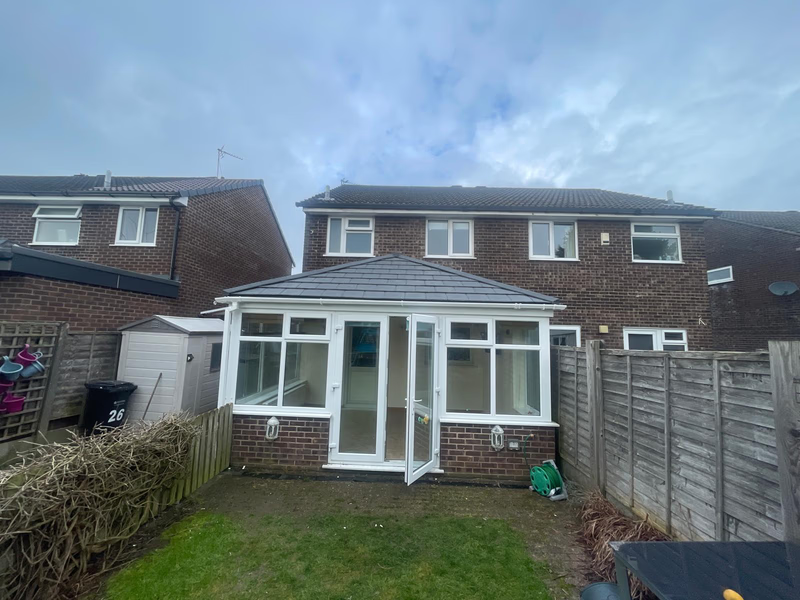
The Edwardian, sometimes called a Georgian conservatory, has a square or rectangular footprint with a hipped roof. Unlike the Victorian's angled bay, the Edwardian's flat front wall makes very efficient use of floor space — the internal area is one of the best of any style for the given external footprint. This makes Edwardians a popular choice for families wanting maximum usable space.
The roof typically has a central ridge with two hip ends, which is more straightforward to tile than a Victorian. Edwardians are a very common roof replacement job and our team has extensive experience with this profile.
Identifying features: square or rectangular plan, flat front wall (no bay), hipped roof with a central ridge, elegant and symmetrical proportions.
Gable-End Conservatory
A gable-end (or Edwardian gable) conservatory has a full-height glazed gable at the front — the end wall rises straight up to a pointed apex rather than having a hip. This maximises the internal height and lets in a large quantity of light through the front gable. The gable section adds complexity to a roof replacement, as the front apex needs careful detailing, but it can create a particularly impressive finished appearance with a tiled roof.
Identifying features: full-height triangular glazed panel at the front, no hip sections on the front face, high internal ceiling, often feels more like a room extension than a traditional conservatory.
P-Shaped Conservatory
A P-shape conservatory combines two different styles — typically a lean-to section at the back and a Victorian or Edwardian section at the side, creating an L or P shaped footprint when viewed from above. These are the largest and most complex conservatories, ideal for homes where the rear garden allows a wide extension. They typically incorporate a kitchen-diner at one end and a sitting area at the other.
P-shapes are the most complex roof replacements, with multiple different roof sections, valleys, and varying pitch angles. They take longer and cost more, but the transformation is usually the most dramatic — particularly as a badly insulated P-shape can feel genuinely uncomfortable across its entire length.
Identifying features: large footprint, two distinct sections with different roof heights or pitches, valley where the two sections meet, usually the most expensive conservatory type.
T-Shaped and Bespoke Conservatories
Some conservatories are entirely bespoke — T-shapes, L-shapes, or custom designs commissioned to fit awkward garden spaces. These are assessed individually. When you request a quote, our surveyor will take measurements of all roof sections, sketch the layout, and prepare structural calculations specific to your configuration. Nothing about a non-standard shape prevents replacement with a tiled system — it simply requires more careful planning.
| Style | Complexity | Typical Price Range |
|---|
| Lean-to | Low | From £1,495 |
| Edwardian | Moderate | £2,500 – £6,000 |
| Victorian | Moderate–High | £3,000 – £7,500 |
| Gable-end | Moderate–High | £3,500 – £8,000 |
| P-shape / Bespoke | High | £5,000 – £12,500+ |
Does My Conservatory Style Affect Whether I Can Have a Tiled Roof?
No — all conservatory styles can be converted to a tiled roof system. The shape affects complexity and price but does not prevent conversion. Our lightweight Eco Friendly tile system weighs just 7.8kg per m², which means it can be installed on virtually any structurally sound conservatory frame without reinforcement, regardless of the original roof design.
Get an Accurate Price for Your Style
The best way to get an accurate quote is to describe your conservatory when you contact us — or simply send a photo. We'll confirm the style, estimate the roof area, and give you a clear price within one working day. Request a free quote here or call us on 0800 019 7529.
Want to talk it through first?
☎️ 0800 019 7529Free advice, no sales pressure